

FAST FOOD WARS

In a market where businesses in general have been struggling with rising costs and customers are watching their wallets, fast food and takeaways seem to be surging ahead - but which franchised brands are leading the way?
According to the triennial Franchising New Zealand 2024 survey, 15% of all New Zealand's franchise brands are businesses in the Accommodation & Food Services sector, the third largest sector represented.
Over 420 businesses in the Accommodation & Food Services (hospitality) sector were liquidated in the last 12 months, according to the June 2026 Centrix data. However, another 3,500+ new hospitality businesses were registered in that period, and a sizeable proportion of those will be quick, or limited service restaurants (often providing what we know in New Zealand as takeaways).
The Restaurant Association of New Zealand estimates that takeaway food services sales in the first quarter of 2026 amounted to $1.1 billion - a 3.4% increase year-on-year. So where is that growth coming from and are any sectors of the QSR market gaining greater market share?
Overseas trends
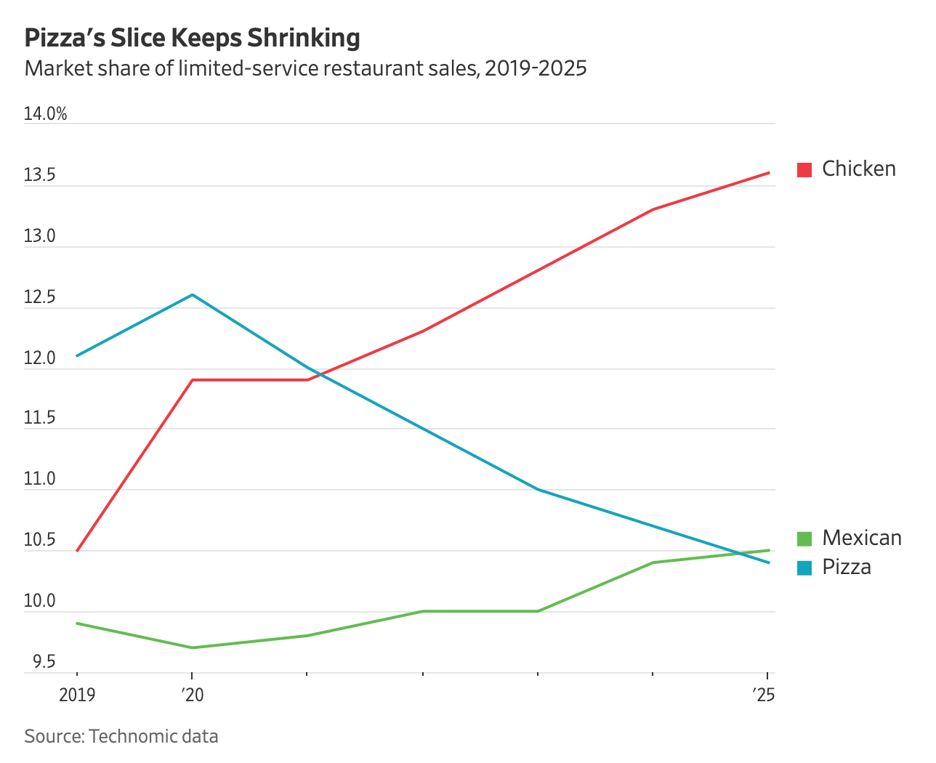
A recent Wall Street article, reported in Bill Edwards' Geowizard newsletter on Substack shows pizza's share of US limited-service restaurant spending has slipped in recent years. The report attributes the drop in sales to the concurrent rise in meal delivery services like Uber Eats, which allow any hospitality business to compete with what used to be almost exclusively the pizza companies' service point of difference.
Over in the States, the ascending alternatives are chicken-based and Mexican-inspired restaurant options - the established burger and sandwich sectors which are larger than pizza's share of the market in the US are not shown in the quoted Technomic data. At least 450 franchised pizza restaraunts are reported to be closing due to underperformance in the US this year.
Uber Eats New Zealand now operates in 178 locations nationwide, reportedly reaching 84% of New Zealand’s population, but despite rapid growth in food delivery options with DoorDash, Kiwi-owned Delivereasy and Uber Eats all operating here, our own pizza takeaway sector seems to be holding its own.
Pizzas vs Burgers
We decided to run a comparison of store numbers for four brands in two of the largest franchised QSR sectors in New Zealand (leaving out the ubiquitous independent fish and ship shops and the myriad of ethnically inspired takeaway options now available across the country). The number of outlets is a close estimate for the month of July, 2026 - some stores will be locally-owned franchises, and some will be company-owned by the master franchise holder (if the brand originated overseas), or the head franchisor (where the brand was founded in New Zealand).
| Pizza franchises | Stores | Burger franchises | Stores |
| Domino's | 158 | McDonald's | 177 |
| Pizza Hut | 146 | Burger King (not sub-franchised here) | 79 |
| Hell Pizza | 79 | BurgerFuel | 62 |
| Sal's Pizza | 46 | RE Burger | 37 |
Both pizza and burger store numbers are actually larger than they were several years ago, indicating that the sector is growing in line with the Restaurant Association's estimates. As in the US, chicken-based takeaway options are also popular here, with 122 KFC stores at last count and new entrant Popeyes expanding to 11 stores in just two years. Neither of these brands are sub-franchised in New Zealand so the stores are all company-owned by the master licence holder.
What if I want to buy a franchise?
If you are thinking about buying a QSR franchise, they can range hugely in investment value depending on the store size, location, projected turnover and strength of the franchise system. It is recommended to undertake strong due diligence to ensure that the numbers stack up and the business will live up to your expectations.
There have been a number of reports in the media recently where a franchisor with a string of failed franchise businesses behind him has continued to recruit franchisees for a burger chain that has only been operating three years, and which already has a track record of failed franchisees. In some cases of franchise failure, there may be circumstances beyond the control of all parties, or the franchisor may be consistently selecting people who are not best suited to be business owners within that system. Wherever the fault lies, by conducting proper due diligence, prospective franchisees can reduce the risk of making a bad investment.
As well as seeking the advice of a franchise-experienced accountant and lawyer, make sure you check the background of the franchisor, talk to a number of different franchisees and ask the hard questions.
last updated 15/07/2026
last updated 15/07/2026
Featured Listings
Westpac New Zealand
Westpac is New Zealand's most experienced bank in franchising and the only bank offering dedicated franchise specialist managers throughout the country....

Goodwin Turner Commercial Lawyers
Goodwin Turner Commercial Lawyers aims to provide a modern, friendly, client-focused and efficient approach to your legal business requirements, with a...

CrestClean
Looking for a simple business with low risk and high profit margins - where you can enjoy a great lifestyle? A CrestClean franchise ticks all the boxes!...

Speed Queen Laundry Systems
Enjoy semi‑passive income with your own Speed Queen self‑serve laundromat. With our expert support you’ll be operating a profitable business in no time,...

